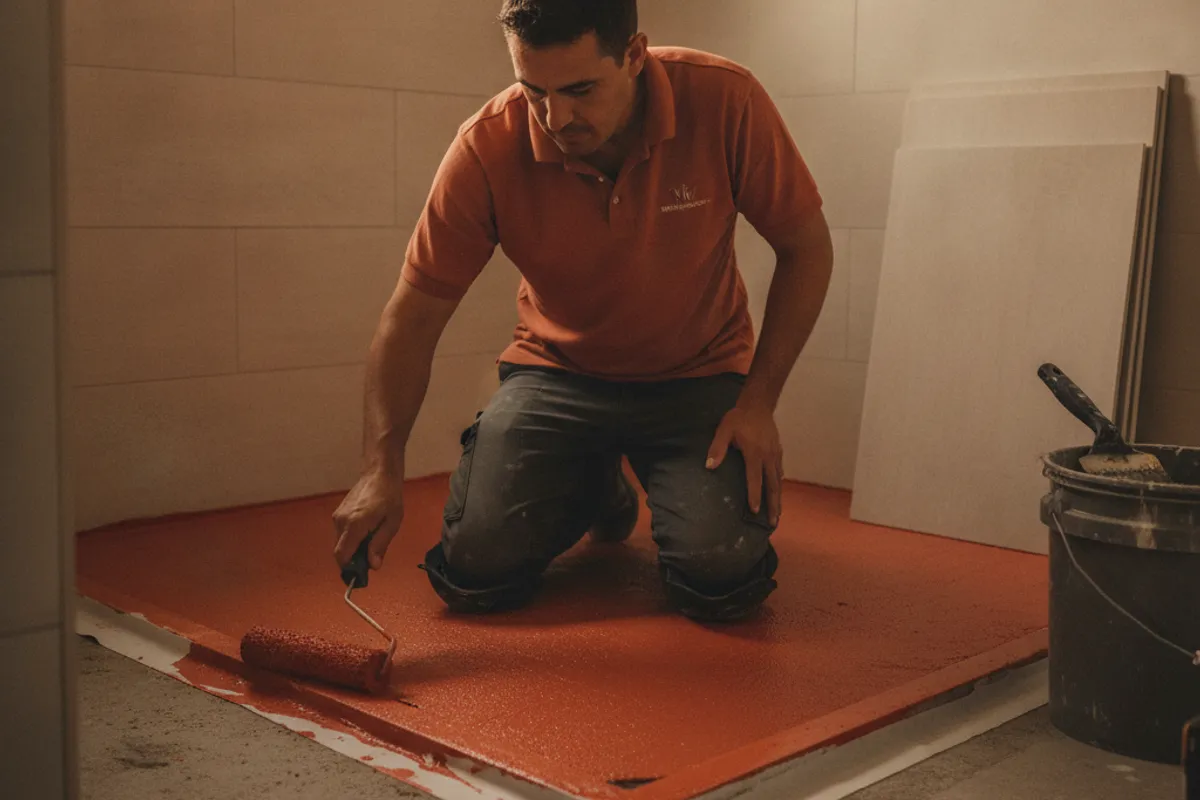
Why shower waterproofing matters more than most homeowners realize
Tile does not waterproof a shower. That is the piece that most homeowners miss. Tile and grout are both water-resistant, but neither is waterproof. Water gets through grout joints over time, through micro-cracks in caulk, and through any point where the grout seal has degraded. In a shower used daily, moisture reaches the backer behind the tile. The question is what happens to it when it gets there.
A properly waterproofed shower has a continuous membrane behind the tile that directs any moisture that penetrates the tile surface into the drain. A shower without that membrane has moisture accumulating in the wall or the shower pan assembly, which eventually causes mold, structural damage, and tile failure.
San Diego has tens of thousands of showers built before 2000 that use outdated waterproofing methods. When those showers get renovated, understanding what system to install is the most important decision in the project.
How older San Diego showers were built
Pre-1990 shower construction in San Diego typically used one of two methods:
Hot-mop pan. A mopped bituminous liner applied to the shower floor assembly by a specialty subcontractor. This is still used in new construction by some plumbers, and it can be effective when properly installed. The problem is when it cracks from movement, puncture, or age. A failed hot-mop liner saturates the concrete float bed underneath the tile, and that moisture has nowhere to go except sideways into the wall assembly.
Felt paper over drywall. The cheapest and least effective method. Standard paper-faced drywall with roofing felt behind it was common in tract construction from the 1960s through the 1980s. This approach relies on the tile and grout to keep water out entirely, which they cannot do long-term. Failure is a matter of when, not if.
Modern waterproofing systems used in San Diego today
Bonded membrane systems are the current best practice. These use a membrane material (sheet or liquid) applied directly to the substrate that becomes part of the system. Water that gets through the tile surface hits the membrane, not the backer, and runs to the drain. The TCNA and most tile industry guidelines now require bonded waterproofing for wet areas.
Schluter Kerdi is the most widely specified bonded sheet membrane in San Diego. It is a polyethylene fabric with fleece laminates on both sides, set in thinset against cement board or directly against drywall. Schluter also makes Kerdi-Band for corners and seams, Kerdi-Drain for floor penetration, and Kerdi-Board as an integrated foam backer. The system is well-tested and widely available in San Diego at Tile Shop, Floor and Decor, and specialty tile suppliers. A standard 36x36 shower stall in Kerdi materials runs $180-$350 in membrane material.
Liquid-applied membranes (Laticrete Hydro Ban, Mapei AquaDefense, RedGard by Custom Building Products) are brushed or rolled onto the substrate, including corners and seams, and cured before tiling. They are faster to apply than sheet membranes on complex geometries and are a good choice for shower niches, curbs, and benches where cutting sheet membrane precisely is time-consuming. Laticrete Hydro Ban is widely used on commercial projects in San Diego. Material cost for a standard shower is $80-$180.
WEDI board is an alternative approach using rigid foam panels that are waterproof throughout the panel body, not just at the surface. The panels are set against studs, the seams are sealed with WEDI seam tape and sealant, and tile is set directly on the WEDI surface. It eliminates the cement board layer and is especially popular in smaller San Diego bathrooms where the wall assembly depth matters.
What a proper installation includes
Regardless of which system is used, a correctly waterproofed shower has:
- A continuous membrane on all wet surfaces: floor, walls, and any ceiling in an enclosed steam shower.
- Membrane coverage up the wall to at least 3 inches above the highest wet line (or to the full height of the shower if it is a doorless walk-in).
- Sealed corners and seams with the appropriate tape and sealant for the system.
- A waterproofed shower floor drain connection so there is no gap between the membrane and the drain body.
- An integration between the floor membrane and the wall membrane so there is no seam at the curb or at the floor-to-wall transition.
- A flood test before tile is set. The membrane should hold water for 24 hours with no loss.
That last point is often skipped on rushed projects. A 24-hour flood test is cheap, takes no labor to run, and is the one check that catches any missed seam or penetration before tile covers it.
What a San Diego homeowner should ask about waterproofing
Before any shower tile project, ask the installer:
- What waterproofing system are you using?
- Is it a bonded membrane or a felt/paper backer system?
- How are you handling the drain connection?
- Will you flood-test the pan before tiling?
If the answer to any of those is vague or the installer says waterproofing is not necessary because the tile will keep water out, that is a sign to look elsewhere. For connecting with experienced, insured San Diego tile crews, see the shower and bath tile service.
What it costs in San Diego
Adding a bonded waterproofing system to a shower project typically runs $300-$700 in materials for a standard shower stall, plus labor. If the existing backer board needs to be replaced (from paper-faced drywall to cement board or WEDI), add $200-$600 for the backer work.
Compared to the cost of tearing out a failed shower tile system five years later, that is a small number. A full shower demo and rebuild runs $3,500-$9,000 in San Diego.
Call (858) 925-5546 to get connected with an insured tile crew in San Diego County that uses proper waterproofing systems.
Does tile waterproof a shower?
No. Tile and grout are water-resistant but not waterproof. A separate bonded membrane system behind the tile is required to keep moisture from reaching the wall structure.
What is the best shower waterproofing system for a San Diego home?
Schluter Kerdi is the most widely used bonded sheet membrane in the local market and is well-suited for standard shower renovations. Liquid-applied systems like Laticrete Hydro Ban are a good choice for complex geometries with niches and benches. WEDI board is a solid option when wall assembly depth is a constraint.
How do I know if my existing San Diego shower has proper waterproofing?
If your home was built before 2000 and the shower has never been renovated, it almost certainly uses the older felt paper or hot-mop approach. Signs of failure include cracked grout at corners, soft spots in the wall above the tile line, visible efflorescence (white salt deposits) on the grout, or mold growth at the base of the wall.