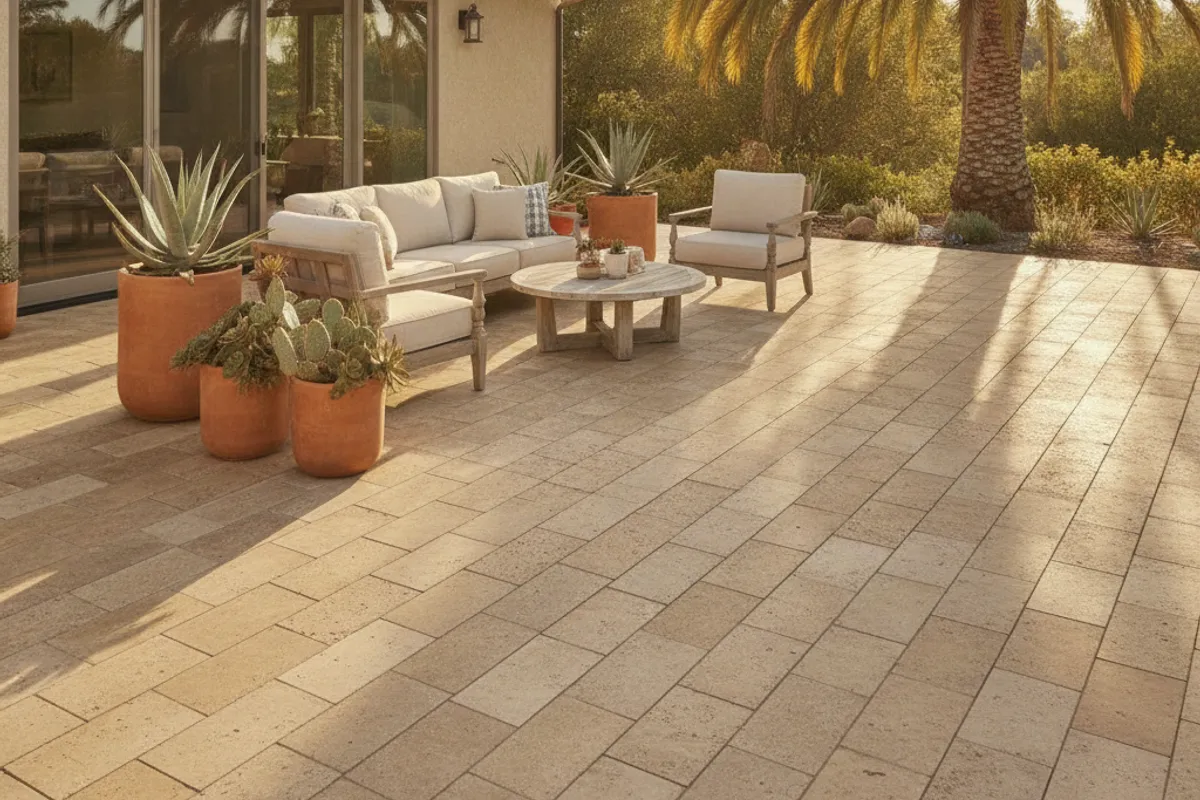
Why outdoor tile in San Diego is different from other markets
San Diego’s outdoor tile conditions are genuinely different from colder climates. The biggest external stressor in Chicago or Denver is freeze-thaw cycling, which cracks tile and pops joints. San Diego rarely freezes, so the focus shifts to four other factors: UV intensity, thermal cycling in the inland zones, moisture exposure at the coast, and the indoor-outdoor flow that most San Diego homes are designed around.
Choosing the wrong tile for an outdoor San Diego project does not usually result in cracking from frost. It results in tile that fades, grout that fails under heat expansion, a surface that becomes slippery when wet, or a material that looks great for a year and erodes from salt air.
Material options for San Diego outdoor tile
Porcelain is the most common outdoor tile choice in San Diego for good reason. High-density porcelain with a water absorption rate below 0.5% holds up to UV, handles the thermal swing between cool marine layer mornings and 85-degree afternoons, and is available in slip-resistant finishes rated for wet outdoor conditions. Textured and matte-finish porcelain in 12x24 or 18x18 format is the practical default for most outdoor applications: patios, pool decks, outdoor kitchens, and covered entries.
Travertine has been the go-to natural stone for San Diego outdoor spaces for decades, particularly in the inland valleys from Poway to Chula Vista where the warm buff tones suit the Spanish Colonial and ranch architecture. Filled and honed travertine holds up outdoors but needs regular sealing. Travertine near a pool can etch from chlorine splashing and needs to be rinsed after pool chemistry work. Unfilled travertine (open pits) collects leaves and dirt outdoors and is harder to clean.
Slate is a durable natural stone option that handles outdoor use well. It is harder than travertine, does not need as much sealing, and its naturally textured cleft surface provides good traction when wet. Darker slate tones absorb heat in the sun, which can be uncomfortable on a pool deck with bare feet in July in Santee or El Cajon.
Concrete tile (including the Saltillo-adjacent manufactured cement pavers) works outdoors but has more maintenance requirements. Standard concrete is porous and requires sealing to resist staining from sunscreen, food, and organics falling from trees.
Ceramic tile outdoors is not recommended for San Diego’s outdoor areas. Ceramic’s higher water absorption rate makes it susceptible to surface damage over time with UV and moisture cycling, and it does not hold up as well under patio furniture and foot traffic as porcelain.
Slip resistance for outdoor applications
The DCOF (Dynamic Coefficient of Friction) wet rating for outdoor tile should be at minimum 0.42, and ideally 0.60 or higher for areas that will be wet consistently (pool decks, outdoor showers). Any tile you are considering for outdoor use should have its COF data available from the manufacturer. If it is not published, ask for it before purchasing.
Polished and high-gloss tile should not be used on outdoor surfaces that will get wet. That eliminates polished marble, high-gloss porcelain, and glossy concrete tile from pool deck and open patio applications.
What the coastal vs. inland environment changes
Coastal zones (Ocean Beach, Pacific Beach, La Jolla, Encinitas, Carlsbad, Oceanside): Salt air accelerates degradation of unsealed natural stone. Travertine and limestone within a mile of the coast need more frequent sealing: annually at minimum. Porcelain in coastal applications does not have this problem. Grout near the coast should be epoxy or a cement grout with a quality silicone sealant applied after curing.
Inland zones (El Cajon, Santee, Ramona, Alpine, Lakeside): The bigger issue is thermal cycling. Temperature swings of 40-50 degrees between winter nights and summer days are common. Expansion joints in the tile field are not optional: they need to be sized and placed per TCNA guidelines (every 20-25 linear feet in the field, at all changes of plane, at the perimeter). Skipping expansion joints in an inland patio leads to cracked tile and grout buckling, typically within two to three years.
Pool decks: Any tile adjacent to or over a pool in San Diego needs to be rated for pool use, resistant to chlorine and salt (for saltwater pools), and slip-resistant when wet. Large-format tile on a pool deck requires a setting system that allows for proper drainage and does not trap water at the surface.
Setting system requirements
Outdoor tile cannot be set on standard interior thinset over a concrete slab. The slab has to be clean, properly cured (at least 28 days for new concrete, longer for thick pours), and treated with a suitable primer if the porosity is high. Setting materials need to be polymer-modified thinset rated for exterior applications.
For tile over any substrate that may experience slight movement (expansive clay soils are common in parts of East County and South Bay), a crack isolation membrane between the slab and the tile adds meaningful protection. See the guide on tile over slab crack isolation for how this works.
Outdoor tile projects also need silicone or polyurethane grout or sealant at movement joints, not more cement grout. The perimeter of a patio, any inside corners, and all changes of plane need flexible joint material.
What fails early on San Diego outdoor tile projects
In order of frequency:
- Grout cracking at perimeter joints and plane changes where expansion joints should have been used
- Natural stone fading or etching from UV and acidic runoff (from pool decks, fertilizer, bird droppings)
- Tile popping off a slab that was not properly cleaned or primed before setting
- Polished or smooth-finish tile becoming a slip hazard after one season of outdoor use
- Grout staining from organic debris in a shaded patio area that does not get enough sun to dry between uses
The bottom line
For most San Diego outdoor applications, a porcelain tile rated for outdoor use with a matte or textured finish and a confirmed DCOF above 0.50 is the right starting point. Natural stone can work with the right maintenance commitment. Expansion joints and exterior-rated setting materials are not optional.
To get connected with an insured tile crew in San Diego County experienced in outdoor installations, see the outdoor and patio tile service or call (858) 925-5546.
What is the best tile for a San Diego patio?
Porcelain with a matte or textured finish rated for outdoor use and a wet DCOF of 0.50 or higher is the most practical choice. It handles UV, thermal cycling, and moisture without requiring sealing. Natural stone works with proper sealing and maintenance.
Does outdoor tile in San Diego need expansion joints?
Yes. Expansion joints are required at the perimeter, at all changes of plane, and in the field roughly every 20-25 linear feet. Skipping them causes grout cracking and tile popping, particularly in the inland zones where thermal cycling is significant.
Can I use the same tile indoors and outdoors in San Diego?
If the tile is porcelain rated for outdoor use with a slip-resistant finish, yes. Polished or high-gloss tile suitable for interior floors is not appropriate for outdoor use where the surface will get wet.