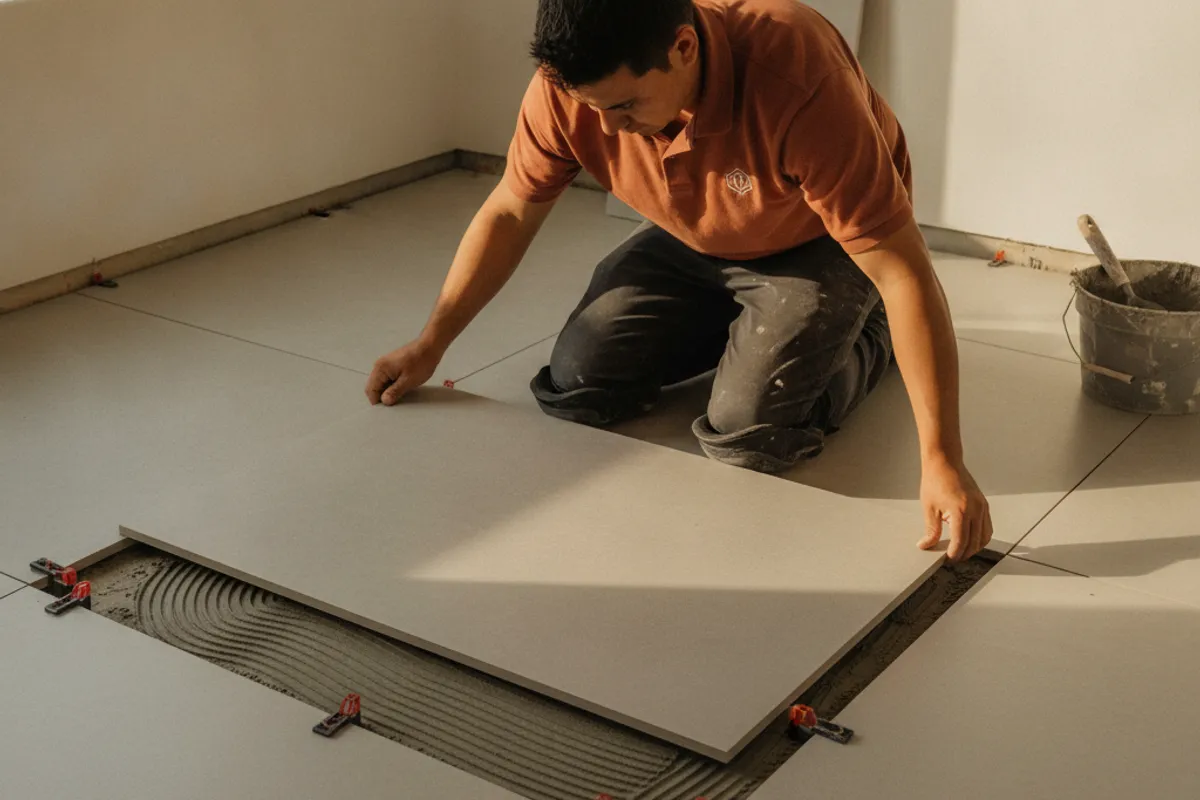
What counts as large-format tile
The tile industry generally considers any tile 15 inches or larger in one dimension to be large-format. In practice, the format that dominates today’s San Diego remodels is 24x24 and 24x48 porcelain. Slab-format tile (48x96 and larger, sometimes called gauged porcelain tile panels or GPTP) is a separate category that requires specialty installation equipment and training.
This post covers the practical range: 18x18 through 24x48 porcelain and ceramic.
The case for large-format tile
Fewer grout lines. The most common reason homeowners choose large-format tile is visual continuity. With 24x24 tile and 1/16-inch joints, a floor reads almost like a single surface. That open, clean look works particularly well in the open-plan homes built throughout Carmel Mountain Ranch, Scripps Ranch, and the Otay Ranch communities in the 2000s and 2010s.
Easier to clean. Grout lines collect dirt. Fewer grout lines mean less scrubbing. For households with pets or kids, the cleaning advantage of large-format tile is real.
Visual scale. Large tile in a large room creates proportion. A 12x12 tile in a 600-square-foot great room reads as busy. The same floor in 24x24 reads calm. Designers working on high-end projects in Rancho Santa Fe, La Jolla, and Del Mar almost universally specify large-format for primary living areas.
Transitions between indoor and outdoor. San Diego’s climate is built for indoor-outdoor living. Matching or complementing the interior tile with the same format outdoors on a covered patio or pool deck creates a visual continuity that works well with sliding glass doors and folding walls. Large-format porcelain handles this application well.
The case against large-format tile (or at least the cautions)
Substrate flatness requirements are strict. The TCNA (Tile Council of North America) standard for large-format tile requires the substrate to be flat within 1/8 inch over a 10-foot span, or 1/16 inch over a 24-inch span when tile joints are narrower than 1/4 inch. Many San Diego homes, particularly those built before 1990 with concrete slab foundations that have experienced minor settling, do not meet this standard without work. Self-leveling compound or grinding can bring a slab into tolerance, but that is an added cost: roughly $1.50-$3.50 per square foot.
Weight and handling. A 24x24 porcelain tile at 3/8-inch thickness weighs about 8-10 pounds. A 24x48 slab weighs 18-22 pounds. Handling, cutting, and setting these tiles takes more labor time per unit than small-format tile. That is reflected in the installed price.
Lippage becomes more visible. Lippage is the height difference between adjacent tiles at a shared edge. With 4x4 tile, a small variation is barely noticeable. With 24x24 tile and thin joints, the same variation creates a ridge that you feel underfoot and see in raking light. Preventing lippage on large-format tile requires a flat substrate, the right setting bed thickness, and back-buttering technique. This is where installer skill matters more than on smaller formats.
Not always right for older homes. A 1950s or 1960s San Diego bungalow in North Park, South Park, or Kensington has character and proportions that large-format tile can fight against. A 12x24 subway-format tile or even a 6x6 cement-look tile can honor the architecture better than a 24x48 modern porcelain.
Outdoor on slopes requires planning. For outdoor patios on sloped sites, particularly in hilly neighborhoods like La Mesa, El Cajon, or the canyonside homes in Mission Hills and Hillcrest, large-format tile on a slope requires careful attention to drainage, expansion joints, and the setting system used. Outdoor large-format tile set without proper expansion joints will fail in the thermal cycling that San Diego’s inland areas experience between winter nights and summer afternoons.
What installers see on large-format projects
The most common problem on large-format tile projects is a substrate that was not properly assessed before tile was purchased. A homeowner chooses 24x24 porcelain based on a showroom display, the tile arrives, the installer starts and finds the slab varies 1/4 inch over 6 feet, and now there is a conversation about whether to skim the whole floor with self-leveler before proceeding.
The fix is simple: have the crew assess the substrate before you buy the tile. A straight edge and a level tell you quickly whether you need prep work. Building that cost into the original budget avoids the mid-project conversation.
For the full guide on what large-format tile installation actually involves, including setting systems and expansion joint planning for San Diego conditions, see large-format tile installation.
When to choose large-format vs. smaller formats
| Room or application | Better choice |
|---|---|
| Open-plan living area, modern home | 24x24 or larger |
| Primary bath, spa aesthetic | 24x48 wall, mosaic floor |
| Older craftsman or Spanish colonial home | 12x24 or 6x6 |
| Outdoor patio, flat or near-flat | 18x18 or 24x24 porcelain |
| Outdoor patio, sloped or complex | 12x24 for easier drainage cut |
| Shower walls, large bath | 12x24 or 24x24 |
| Shower floor | 2x2 or 4x4 mosaic regardless of wall format |
The bottom line
Large-format tile looks great when done right and installed on a properly prepared substrate. The visual benefits are real. So are the substrate requirements and the additional prep cost when the slab is not already flat. Ask your installer to assess the floor before you finalize your tile choice.
Call (858) 925-5546 to get connected with an insured tile crew in San Diego County who can evaluate your substrate and give you a written quote.
What substrate flatness is required for large-format tile?
The TCNA standard requires 1/8 inch flatness over a 10-foot span. For tiles with joints narrower than 1/4 inch, the tolerance tightens to 1/16 inch over a 24-inch span. Many pre-1990 San Diego slabs need self-leveling compound to meet this.
Is large-format tile more expensive to install than smaller tile?
Yes, typically 10-25% more in labor due to substrate prep requirements, handling, and the precision needed to prevent lippage. The substrate leveling cost is separate and depends on how out-of-flat the floor is.
Can large-format tile be used outdoors in San Diego?
Porcelain large-format tile works well on flat or near-flat outdoor patios. Slopes require more careful planning for drainage and expansion joints. Use a tile and setting system rated for exterior freeze-thaw cycles even though San Diego rarely freezes, because thermal cycling in the inland valleys still stresses joints.