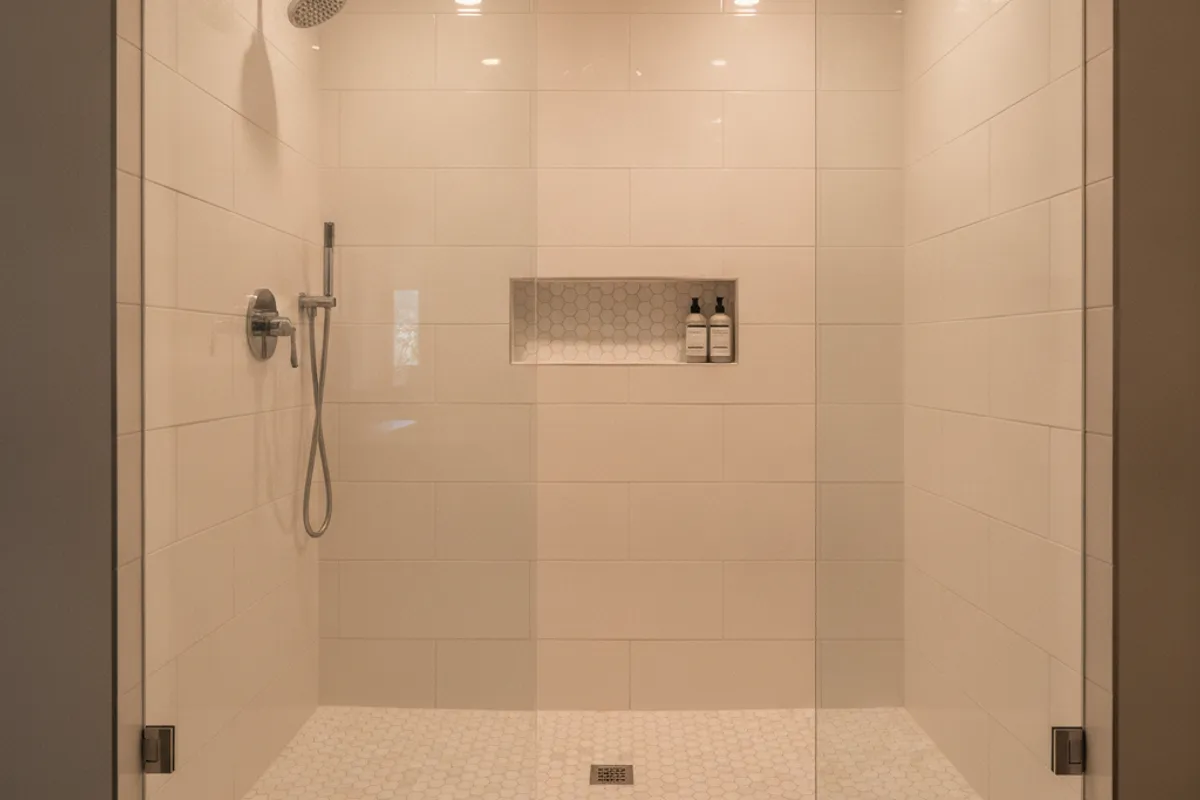
What the tile has to do in a shower
A shower tile is not just a visual finish. It covers a waterproof membrane, lives in daily moisture, gets walked on in wet feet, and sits in a room that cycles through temperature and humidity dozens of times a week. The right tile handles all of that without failing the grout joints, cracking the field tile, or creating a slip hazard.
Here is what works well in San Diego showers and what the crews we work with see go wrong.
Shower floor: small format for traction
The floor of a shower drains to a center or linear drain, which means it is pitched. Tile set on a pitch has to grip wet bare feet. The DCOF (Dynamic Coefficient of Friction) rating for wet floors should be 0.42 or higher. Most large-format tiles do not meet that on a wet pitched surface without added texture.
The classic solution is 2x2 or 4x4 mosaic tile. The grout lines themselves act as grip lines. Porcelain mosaic sheets in these sizes are the most common and most practical choice. They are available in matte and textured finishes that maintain grip underfoot.
For homeowners who want a cleaner visual on the floor, 6x6 porcelain in a matte or textured finish can work if the DCOF rating is confirmed and the tile is properly pitched to the drain with no low spots.
What does not work: large-format polished tile on a shower floor. Even if the installer can pitch it correctly (which is harder with 24x24 tiles), the smooth polished surface is slippery when wet. Polished marble and high-gloss porcelain are the two most common offenders in San Diego shower renovations that end up being re-tiled.
Shower walls: more flexibility, but material still matters
Wall tile in a shower is not pitched and does not carry the same slip requirement. The constraints here are moisture resistance, adhesion, and grout joint performance.
Porcelain is the most common wall tile in San Diego showers for good reason. It is dense, absorbs almost no moisture, and is available in every size from 3x6 subway to 48-inch slabs. Rectified porcelain with tight joints (1/16 inch) gives a clean contemporary look that works in the newer construction around Otay Ranch, Scripps Ranch, and the Carmel Valley communities.
Ceramic is fine on shower walls. Most subway tile is ceramic. It is easier to cut, lighter to handle, and less expensive than porcelain. The glaze provides good moisture resistance on the surface. The tile body is more porous than porcelain, but that is not a problem on walls above the waterproof membrane.
Natural stone on shower walls is a design choice that brings real maintenance requirements. Marble and travertine both need sealing before use and regular re-sealing. In a shower that gets daily use, re-seal every 12-18 months. Unsealed natural stone in a shower will absorb moisture and eventually show staining, efflorescence, or deterioration. If you want the look, the discipline of maintenance has to come with it.
Glass tile is a wall option that reads well in bathrooms near the beach (La Jolla, Encinitas, Mission Beach). It does not absorb moisture, is easy to clean, and reflects light. The limitation is that it requires a white or gray setting bed (tinted mortar shows through) and precise installation because lippage is very visible in reflective surfaces.
For the full breakdown of shower installation and what the waterproofing system underneath looks like, see the guide to shower and bath tile.
Size and grout joint considerations
Large-format tile on walls (12x24, 24x24, or larger) is popular and works well if the substrate is flat. The Tile Council of North America (TCNA) standard for large-format tile installation requires substrate flatness within 1/8 inch over 10 feet. Many older San Diego homes do not have walls that flat out of the box, which means additional substrate prep.
Grout joint width affects the look and the maintenance. Narrow joints (1/16 to 1/8 inch) require rectified tile (precision-cut edges) and produce the sleek continuous surface you see in newer tile designs. Wider joints (1/4 to 3/8 inch) are more forgiving on older homes with less-flat walls and allow for slight variation in handmade or tumbled tiles. Wider joints in showers need epoxy grout or a sanded grout with a quality sealer to resist mildew.
What San Diego installers see go wrong
The three most common shower tile failures in San Diego homes:
Waterproofing skipped or done incorrectly. In homes built before 2000, the original shower often used a felt liner or nothing at all. When those fail, the tile eventually cracks as the substrate shifts. A proper modern shower uses a bonded membrane system (Schluter, Laticrete, WEDI) or liquid-applied membrane behind the tile. There is no shortcut here.
Polished tile on the floor. Already covered above, but worth repeating: polished natural stone or high-gloss porcelain on a wet shower floor is a genuine safety issue, not just a maintenance problem.
Wrong setting materials. Standard thinset used in wet areas fails over time. Shower installations should use a polymer-modified thinset rated for wet areas and a grout rated for the joint size and application. This is a materials cost difference of $50-$150, which is the cheapest line item on the project.
A practical guide by shower type
Standard 36x36 or 60x32 shower stall in a guest bath: 2x2 or 4x4 porcelain mosaic floor, 3x6 or 4x12 ceramic or porcelain wall tile. Practical and durable.
Walk-in shower in a primary bath: Large-format porcelain wall tile (12x24 minimum), mosaic or textured porcelain floor. Add a linear drain if you want large-format floor tile and are willing to do the larger substrate prep.
Spa-style wet room or steam shower: Natural stone or large-format porcelain, steam-rated waterproof membrane throughout, epoxy or urethane grout. Higher budget, higher maintenance, worth it if the lifestyle supports it.
To get connected with an insured tile crew in San Diego County that can assess your shower and give a written quote, call (858) 925-5546.
What is the best tile for a shower floor in San Diego?
2x2 or 4x4 porcelain mosaic tile is the most practical choice. The small format works with the slope to the drain and the grout lines provide traction on wet feet. Look for tiles with a DCOF rating of 0.42 or higher.
Can I use large-format tile in a San Diego shower?
On walls, yes. On the floor, only with a linear drain and a textured or matte finish with a confirmed wet DCOF rating. Polished large-format tile on a shower floor is a slip hazard.
How often does natural stone tile in a shower need to be sealed?
In a daily-use shower, natural stone should be sealed every 12-18 months. A quick water-bead test tells you when resealing is due: drop water on the surface and if it soaks in instead of beading, it is time.